Cinema
Malta
“Luzzu”: Alex Camilleri’s Cinema of the Real
21 June 2022
The film denounces the dramatic situation of Maltese fishermen by telling a story about the dignity of those who fight for survival against major economic interests. After having garnered significant international awards, such as the Special Jury Award at the Sundance Film Festival in Toronto and at the Independent Film Festival in Boston, the film has just been screened at the Festival of Mediterranean Citizens in Catania.
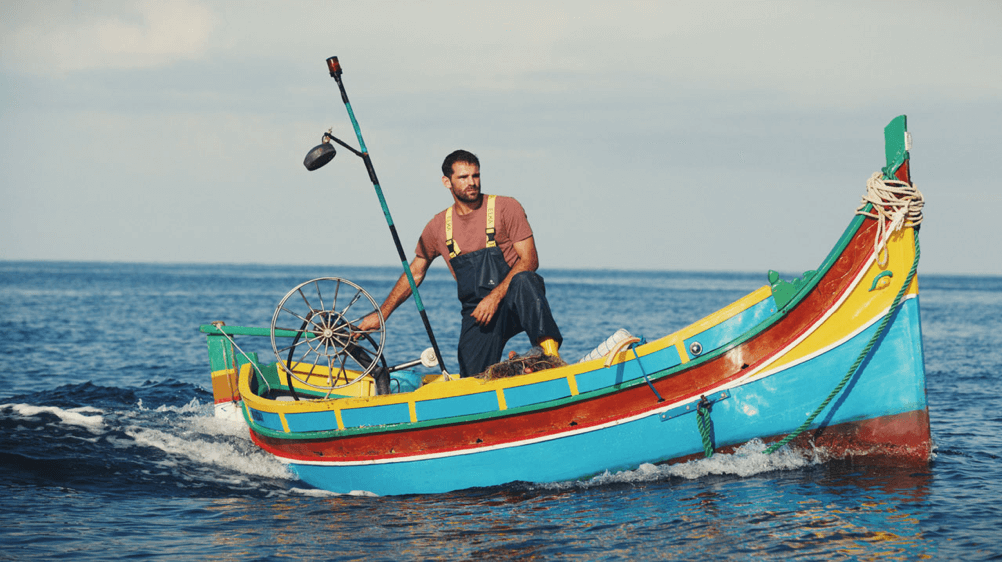
A still from the film portraying the protagonist Jesmark Scicluna, a non-professional actor in his first acting experience aboard his luzzu.
Jesmark (Jesmark Scicluna), a young fisherman from Marsaxlokk discovers yet another leak in the keel of his "Ta 'Palma", a traditional wooden luzzu1 built by his great-grandfather and used, before him, by his grandfather and father. Meanwhile, his newborn son is diagnosed with a growth disorder that requires time-consuming and expensive treatment.
With the boat out of order and the sea plundered by large fishing boats, Jesmark struggles to place his goods with fierce auctioneers and contemptuous of small independent sellers. The survival of his family is in danger and the relationship with his wife Denise (Michela Farrugia) also begins to falter, weighed down by the constant interference of a mother-in-law who does not share his life choices.
In a succession of unfortunate events, the protagonist finds himself involved in an illegal fishing trip for the black market that violates the seasonal stop to protect some fish species. This film tells the personal story of a man who is increasingly alone and distressed by insurmountable economic difficulties. A story that is intertwined with more universal themes such as love, friendship, dignity, social divide, corruption and the collapse of ancient local traditions that risk disappearing, crushed by international interests.
His unsafe luzzu thus becomes the symbol of an extremely precarious socio-economic condition threatened by the European Union policies that impose new rules destined to change its fragile balance.

The film director Alex Camilleri.
Climate change
The measures adopted by Brussels indeed favour large ships from the Atlantic, Japan and Australia while small local fishermen are forced to deal with ruthless commercial logic that risk triggering a desperate war between the poor.
The low-impact artisanal fishing that has been practiced for generations in Malta and elsewhere in the Mediterranean is discouraged by funding programmes that support conversion while international fleets make millionaire earnings.
The theme of the environment occupies a central place in the film and raises the delicate issue of the uncertain future of an ancient and tiring profession endangered by climate change and intensive fishing methods that devastate the seabed, thus upsetting the marine ecosystem.
With rarefied, almost whispered dialogues, and a narration through images accompanied only by background sounds, Jesmark's story is captivating and moving, arousing strong empathy for the dramatic choices that he is forced to face. Due to its sober and balanced style and its deeply human realism, the debut feature film by the young Maltese-American director has been defined by many as "Dardennian" and almost seems to belong to the documentary genre.
Released in 2021, the film has been screened in more than 12 countries and has already garnered prestigious international awards, such as the Special Jury Award at the Toronto Sundance Film Festival, the Boston Independent Film Festival (IFF) and the Annapolis Film Festival, just to mention a few.
“From the very beginning of Luzzu, it was imperative that Malta be what it is, that the cast and crew were almost entirely local and that we would use the Maltese language”, said Camilleri in an interview. "Of course, these choices had an ethical component, but they also represented a very rich creative opportunity: that of telling a story about a place and people who had practically no representation on a stage as important as the Sundance Film Festival.
In order for Malta to be itself, I stayed away from postcard views. We shot in places that were intentionally difficult to control, with traffic or construction going on, because that kind of chaos is true of Malta, as are its picturesque sides. I was determined not to round the corners ”.
Translated by Elizabeth GRECH
1. It is said that luzzi actually arrived on the archipelago some 3,000 years ago when the Phoenicians from Lebanon settled in the bay of Marsaxlokk, the country’s second largest port, and are still valued today for their endurance and stability. In recent decades, sails have been replaced by engines and together with fishing boats, they are now mainly used in the tourist sector. Fishing boats can be recognised by the letter F on the hull, short for fishermen. These traditional Maltese boats are colourful, have two eyes on the prow as a symbol of protection. In the past they also featured on the old circulating lira.