Politics
Palestine
Endless Horror
15 October 2023
The military operation carried out on 7 October in southern Israel by the Ezzedine al-Qassam brigades, the armed wing of the Hamas party, killed 1,200 people and wounded 2,700. A few hours later, Netanyahu's army attacked the Gaza Strip proclaiming a total siege of a territory already harassed by the harsh embargo that has been in place since 2007. The provision of water, electricity and food were cut off and according to the local authorities the bombing has so far caused 1,949 casualties and more than 6,500 injured, mostly civilians.
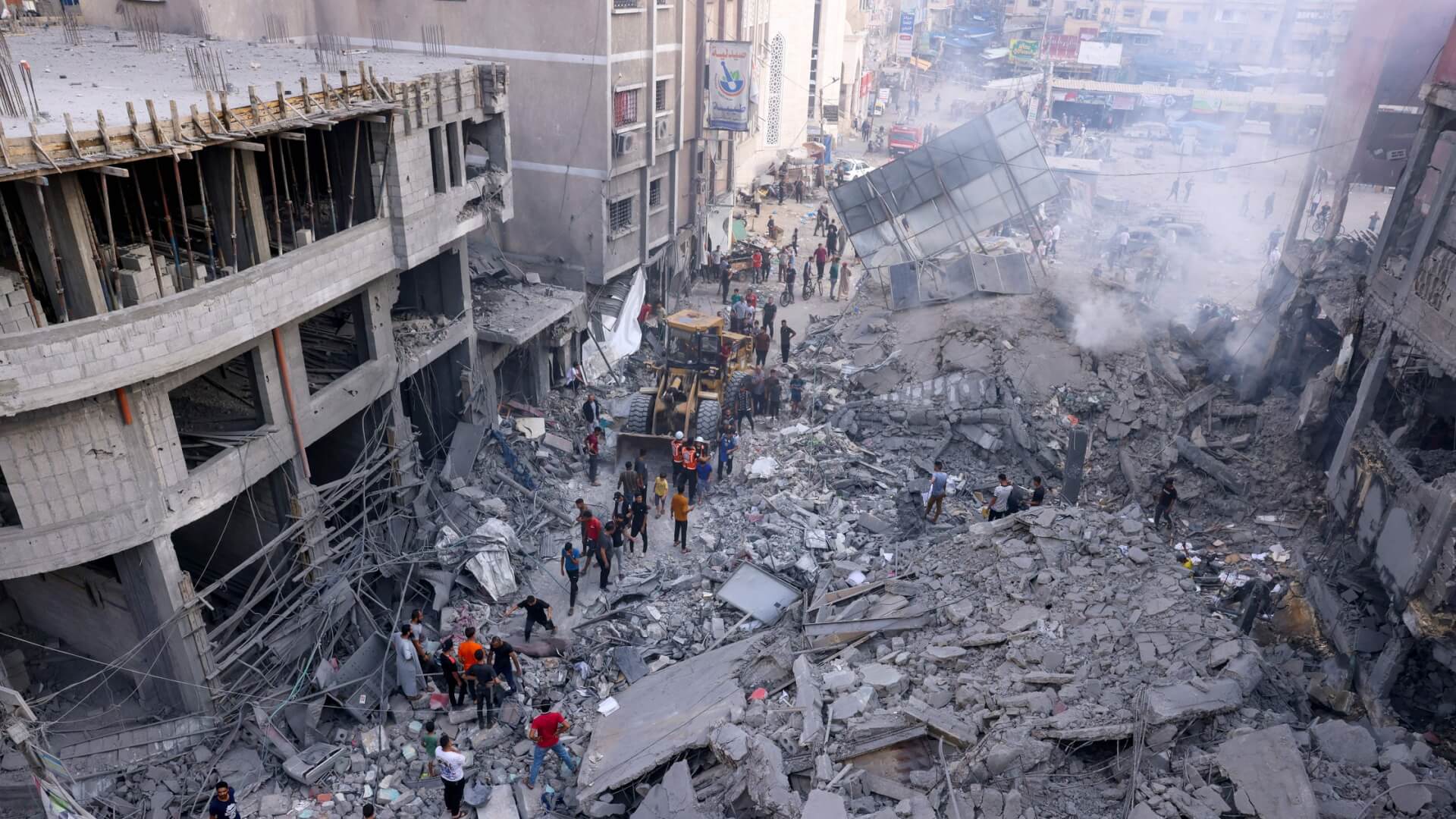
In the rubble of the Gaza Strip, October 2023, Said Khatib/AFP, source Getty Images.
At dawn on 7 October, the Ezzedine al-Qassam Brigades, the armed wing of the Hamas Islamist party, launched an attack on southern Israel by land, sea, and air, with an unprecedented long-range rocket attack. The operation killed 1,200 people and wounded 2,700 (11 October figures), taking one of the world’s best trained armies by surprise and sowing panic and despair among the population.
“In a few days Israelis went through what Palestinians have experienced as a matter of routine for decades, and are still experiencing – military incursions, death, cruelty, slain children, bodies piled up in the road, siege, fear, anxiety over loved ones, captivity, being targets of vengeance, indiscriminate lethal fire at both those involved in the fighting (soldiers) and the uninvolved (civilians), a position of inferiority, destruction of buildings, ruined holidays or celebrations, weakness and helplessness in the face of all-powerful armed men, and searing humiliation”, commented Israeli journalist Amira Hass in the daily Haaretz. “We told you so. Ongoing oppression and injustice explode at unexpected times and places. Bloodshed knows no borders”. The world has suddenly turned upside down and the daily nightmare of the Palestinians has shattered the façade of normality that has characterised Israeli life for decades".
Shortly after the incursion, the Tel Aviv government announced Operation Steel Swords: the Gaza Strip's water, electricity and food supplies were cut off and the entire territory was declared under siege. Bitterly condemned by the UN because it violates international law, the action has so far resulted in the deaths of 1,949 people, mostly civilians, more than 6,500 injured and has razed entire neighbourhoods to the ground.

Mohammed Deif, the commander of the Ezzedine al Qassam brigades, called the military operation in southern Israel the 'Flood of Al Aqsa' in reference to the Esplanade of Mosques in Jerusalem, the third holy site of Islam of which Hamas proclaims itself the protector. Source: Al Majalla.
The Israeli Prime Minister, Benjamin Netanyahu, also had the Rafah border crossing with Egypt bombed, rendering it unusable. In recent days there have been numerous clashes on the border with Lebanon between Israeli soldiers and Hezbollah, and some rockets have also reached Syria. In recent hours, Tel Aviv’s air raids have hit the airports of Damascus and Aleppo, probably targeting some weapons depots sent by Iran to Hamas.
On 13 October, Netanyahu also ordered “the evacuation of all civilians from Gaza for their safety and protection”. The UN has called for the order to be withdrawn in order to “to prevent an already tragic situation from turning into a calamity”. The NGOs Actionaid and Terre des Hommes have issued appeals against this measure. Meanwhile, UNRWA, the UN office for Palestinian refugees, has also left its Gaza City headquarters and moved further south.
Over 2 million people live in the Gaza Strip, crowded on top of each other in just 360 square kilometres. The poverty rate is 62 % and unemployment 47 %. Power outages even in 'normal' times reach up to 12 hours a day, 78 % of the water is undrinkable, and some 275,000 families survive solely on World Food Programme subsidies. Israeli abuses of power and military aggression are the order of the day, making the population's living conditions increasingly precarious and exasperating.
In fact, since the political rise of Hamas, all successive governments in Tel Aviv have continuously attacked Gaza without ever having suffered specific attacks by the party militia before. Operations Summer Rains and Autumn Clouds were carried out in 2006, Hot Winter in 2008, Cast Lead in 2009, Pillar of Cloud in 2012, and Protective Edge in 2014. In addition to these large-scale campaigns, there were numerous smaller-scale events: between January and September 2023, 250 Palestinians died at the hands of the occupation forces.

A map published by Le Grand Continent has so far identified three types of reactions: Western countries condemning the attack and supporting Israel, and these are joined by other states such as India and Kenya; a small minority of governments defending Hamas while the overwhelming majority declare themselves neutral, limiting themselves to warding off further escalation of the conflict.
“Hamas’s objectives in the operation are no secret. First, retaliate and punish Israel for its occupation, oppression, illegal settlement, and desecration of Palestinian religious symbols, especially Al-Aqsa Mosque in Jerusalem”, analyst Marwan Bishara explains on Al Jazeera. “Second, take aim at Arab normalisation with Israel that embraces its apartheid regime in the region; and lastly, secure another prisoner exchange such as that Hamas’s leader in the Gaza Strip, Yahya al-Sinwar who spent over 20 years in an Israeili prison”.
But the party elected in 2006, which has forcibly taken control of the territory since 2007, should in no way be confused with the Gazawi population, nor should the latter be blamed for the atrocities committed by Islamic extremists. The attack on 7 October will not help the Palestinian cause in any way, and the one to pay the worst consequences is, as always, civil society, already harassed by the extremely harsh embargo that has been in place since 2007.
The vicious attack by the guerrillas against unarmed civilians is in effect a terrorist act and a heinous crime against humanity that deserves unanimous condemnation by the international community. Nevertheless, the violent reprisals of the government in Tel Aviv must provoke an equally firm reaction from public opinion and governments worldwide.
The Israeli state is once again staining itself with heavy and heinous crimes that are in every way comparable to those suffered at the hands of the Ezzedine al-Qassam brigades. The aggravating factor is that, in this case, we are not dealing with the violent actions of small radicalised groups, but rather with systematic and consolidated strategies to the point of being an integral part of the policy of violent territorial occupation of what still calls itself 'the only democracy in the Middle East', with the approval of the United States and the European Union.
Exactly fifty years after the Yom Kippur War (6-25 October 1973), yet another macabre chapter opens in a dramatic and bloody conflict that seems impossible to put an end to, and which threatens to engulf the entire Middle East chessboard in a chasm with unimaginable consequences.
Translated from Italian by Elizabeth Grech